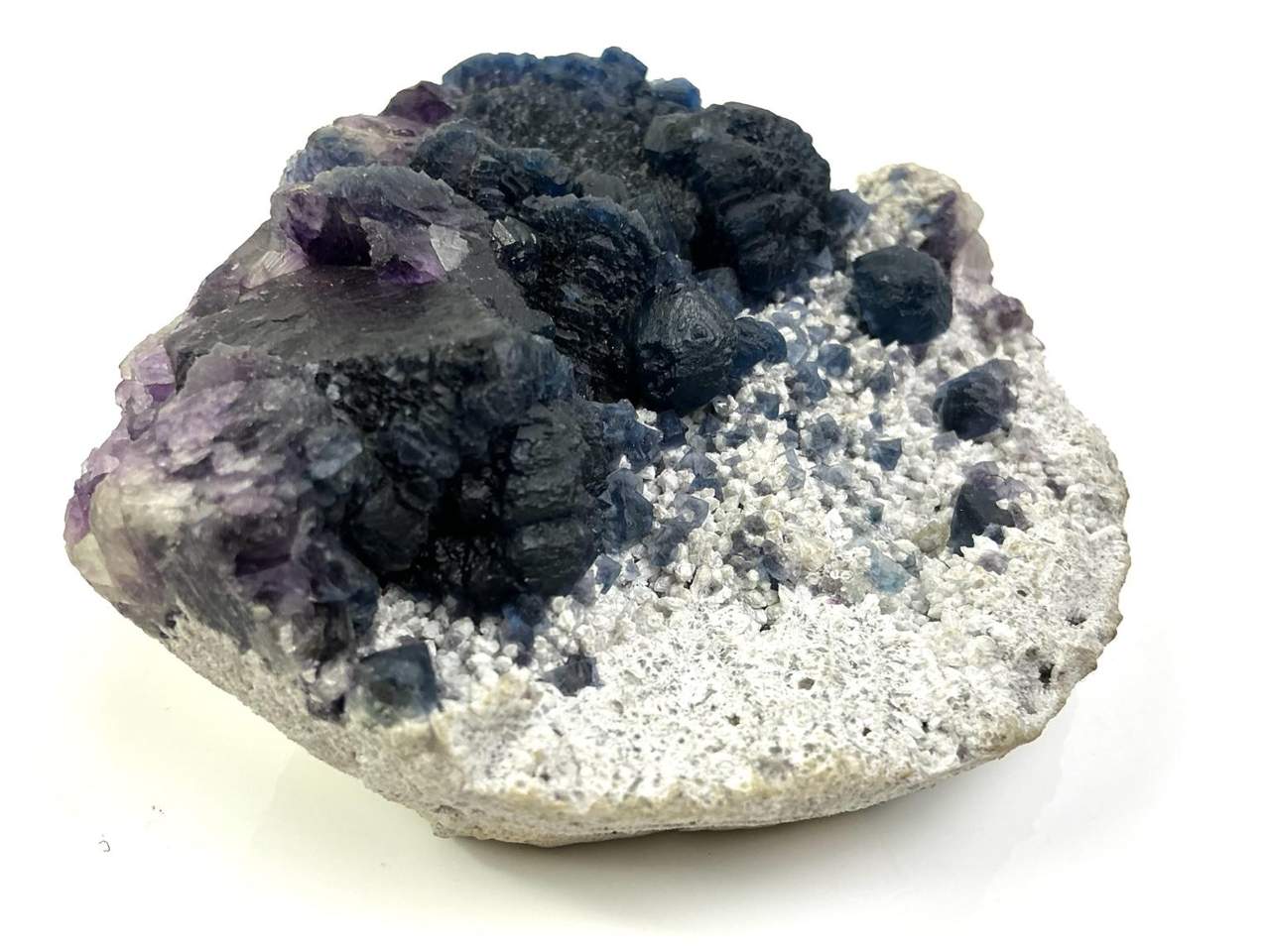
One natural mineral specimen
Blue Fluorite on Dolomite / Quartz · 305 g
Huanggang Mines, Keshiketeng Co., Chifeng, Inner Mongolia, China
£100
Postage: £3.70, added to your specimen price before payment. Choose the region matching your delivery address.
International rates are for parcels up to 2 kg. Contact Avalon before buying heavier or oversized pieces. Royal Mail 24 and 48 are service names, not guaranteed arrival times.
Description
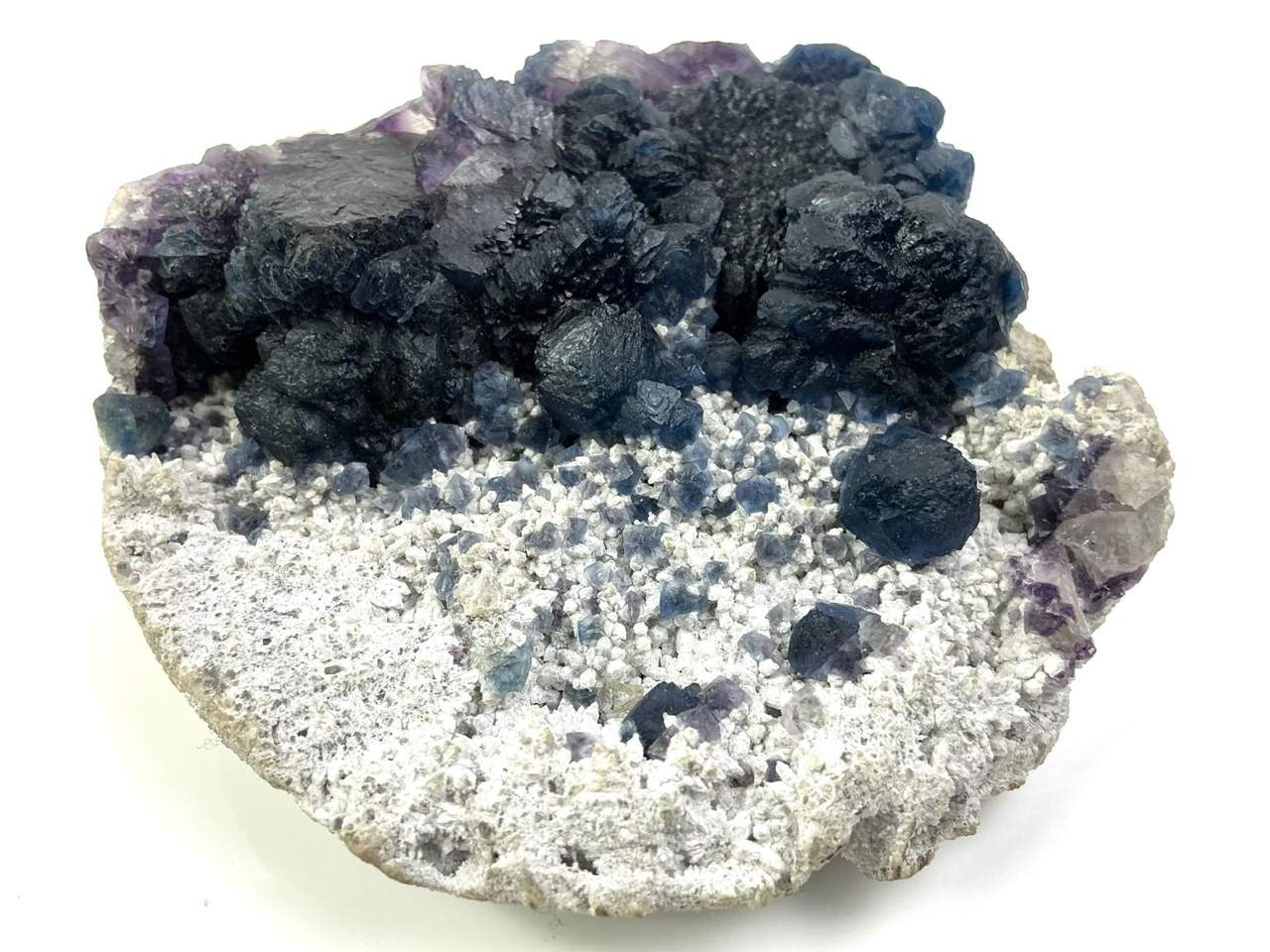
Deep blue Fluorite crystals form a textured cluster across a white, finely crystalline matrix. Smaller blue crystals scatter over the pale surface, with purple and translucent areas visible around the edges.
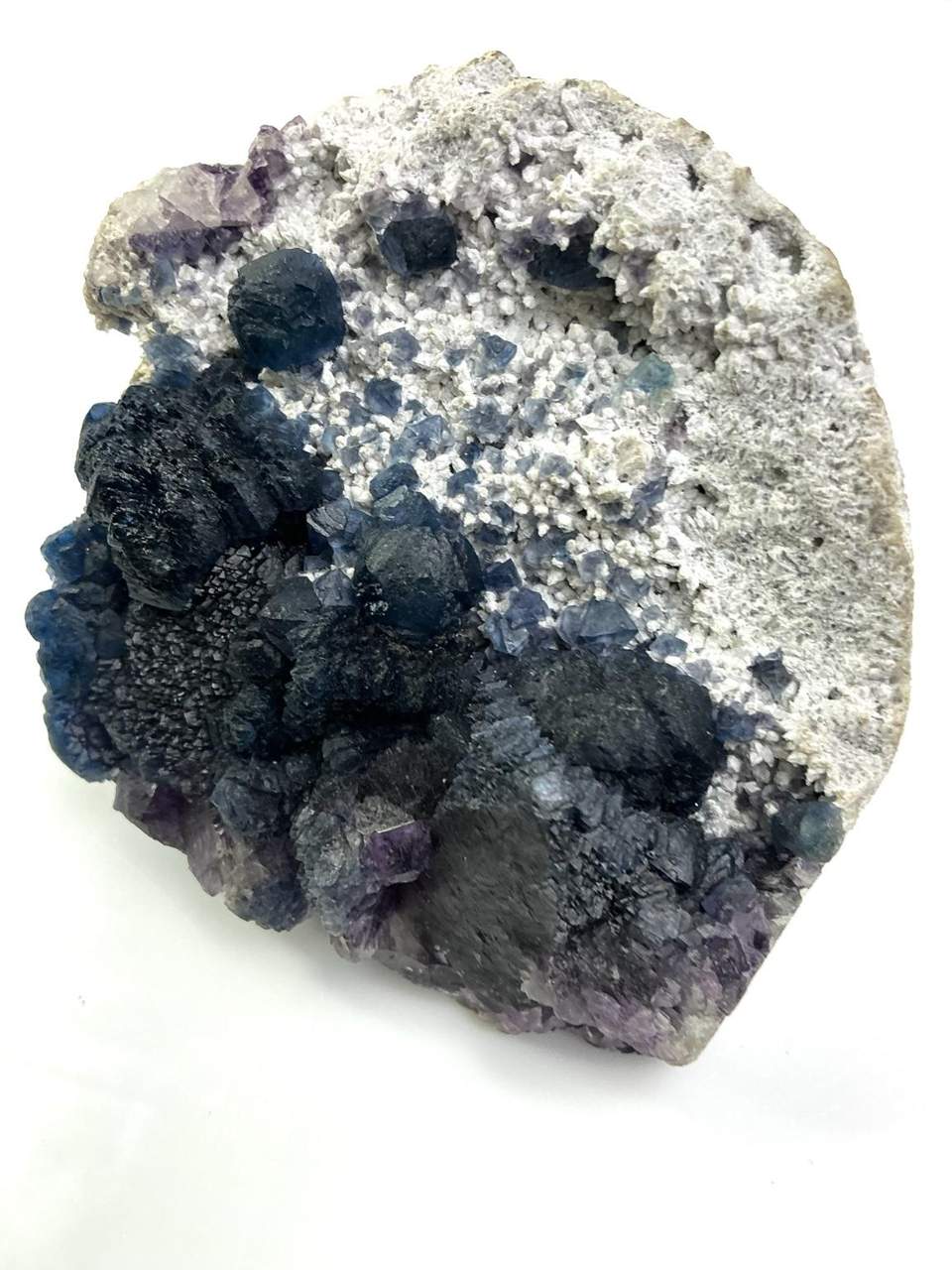
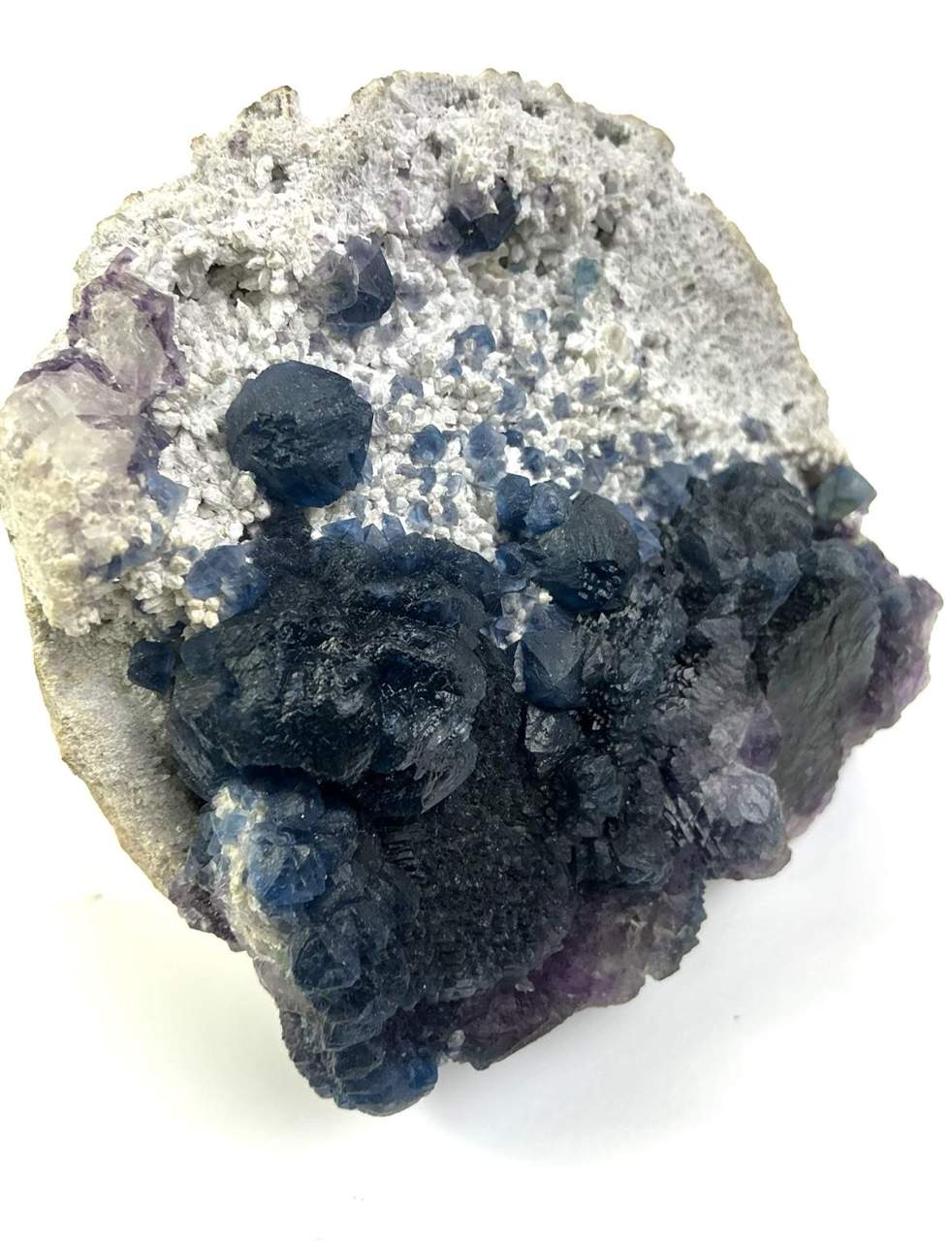
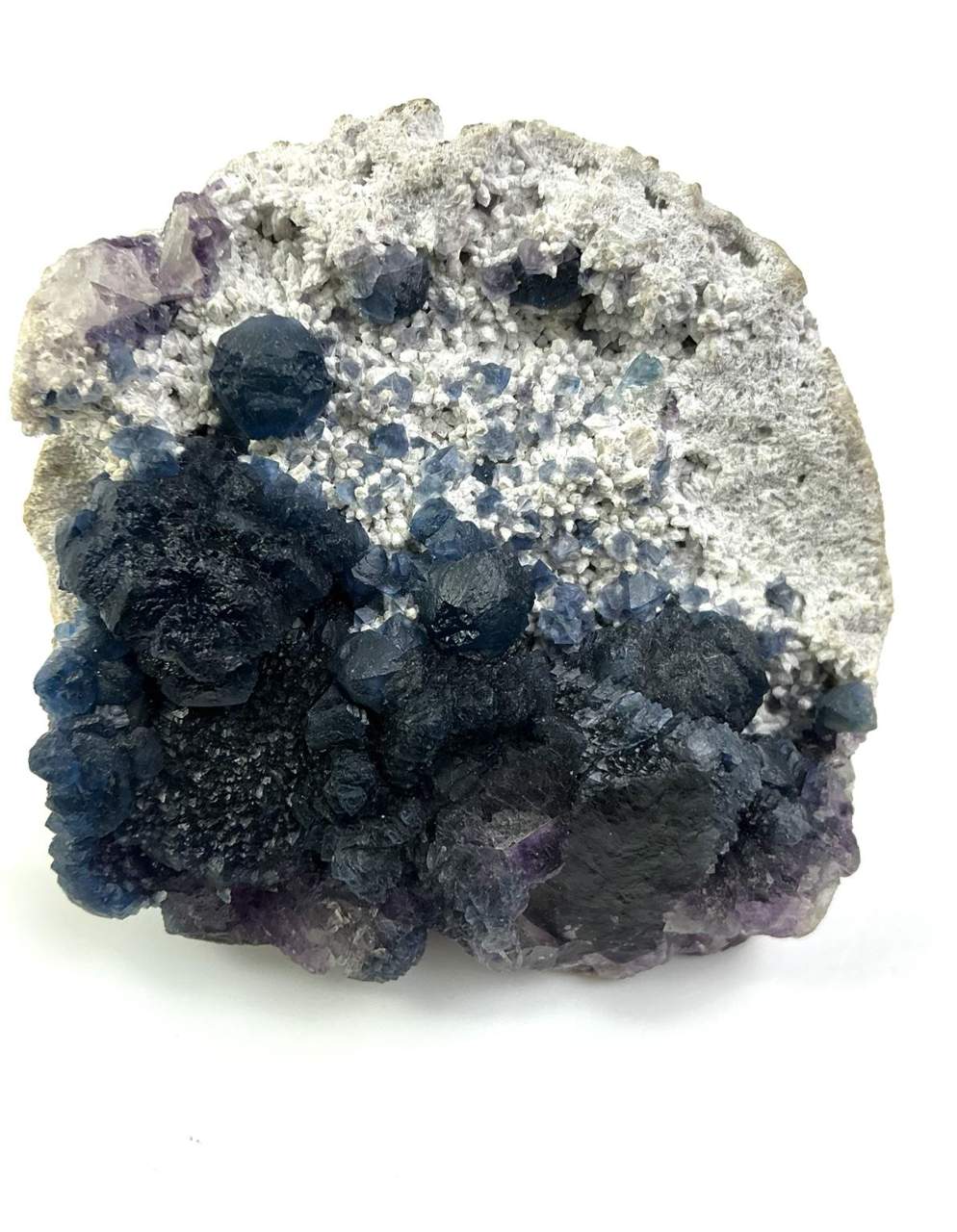
The larger crystals show rounded outlines and intricate surface texture, contrasting with the small blue crystals spread across the white matrix. Purple areas around the rim add further colour, while the angled photographs show the cluster's depth.
The locality is recorded as Huanggang Mines, Inner Mongolia, China. The associated minerals are supplied as Dolomite / Quartz.
I have shown this exact specimen from five angles. You will receive the mineral photographed. Colour and reflections vary with lighting and screen settings.
The crossing arrangement described above is an important part of the specimen’s silhouette. It lets the direction of individual crystals be followed through the group, with open spaces making their outlines more apparent. Intersecting crystals alone do not establish a specific twin law; here the description concerns the visible arrangement rather than a laboratory-confirmed crystallographic relationship.
The accompanying Quartz brings a silicate crystal habit into the association. Its surfaces and crystal outlines contrast with the featured mineral, giving the specimen more than one kind of growth to examine. The way the minerals occupy the same piece is part of its character: the setting retains their natural relationship and adds depth to the overall display.
The recorded Dolomite adds a carbonate association to the specimen. Its contrasting surface character helps separate the featured growth from the material around it. This relationship gives the piece another point of interest beyond the principal crystals: it can be appreciated both for the main mineral’s habit and for the way the minerals are arranged together.
Fluorite is calcium fluoride and crystallises in the cubic system. Cubes and octahedra are among its familiar forms, but intergrowths, modified faces and changes during growth can produce much more complex outlines. This combination of recognisable geometry and considerable variation makes Fluorite a rewarding mineral to collect by both crystal habit and locality.
Fluorite can be colourless or show a wide range of colours, sometimes within one specimen. Transparency, crystal thickness and illumination influence how those colours appear. Its glassy faces contrast with more textured areas and any accompanying matrix. Colour zoning and fluorescence are separate properties; a particular response under ultraviolet light should only be expected where it has been recorded for the individual piece.
The recorded origin is Huanggang Mines, Keshiketeng Co., Chifeng, Inner Mongolia, China. Within a collection of Fluorite specimens, this locality gives the piece a geographical identity alongside its particular crystal habit and natural setting.
The specimen measures 85 × 80 × 40 mm, with a recorded weight of 305 g. The proportions give a useful guide to its place in a display, with the individual crystal arrangement and mineral association remaining the principal points of interest.
Fluorite has well-developed cleavage and should be supported by its stable matrix or mount. Avoid pressing on projecting cubes or corners. A secure indoor position allows the natural geometry and colour to be appreciated while keeping the exposed growth protected.